
Platform 02 · ADC-ready
Thermicra™
Ultra-high concentration formulation for subcutaneous injection
A proprietary formulation platform for delivery of biologics, optimized for ADCs.
Thermicra for your program
mAbs · ADCs · AOCs · Bispecifics · Proteins
300–600mg/mL
Concentration
For antibodies, and 300–400 mg/mL for ADCs.
By hand
Injectability
Injects smoothly and gently by hand, and an autoinjector can be applied where needed.
ICH
Stability
Biologics stability assessed under ICH guidelines, with stability secured on model drugs.
Proven
ADC compatibility
ADCs are more hydrophobic than antibodies, yet our process concentrates them to ultra-high levels — with a strong PK profile and local tolerability confirmed.
01 — The problem
What Thermicra solves
For patients and hospitals
Long IV infusions
High-dose biologics are often given as hospital IV infusions that take hours, in a chair, with a nurse watching.
Complex preparation, high cost of care
Each IV dose is calculated, reconstituted and diluted — cytotoxics are compounded in a biosafety cabinet — then infused and observed. Every step costs pharmacist, nurse and chair time, and is a chance for error.
8 → 3steps per dose, from pharmacy to patient, with a ready-to-use syringe
For the molecule
Subcutaneous volume limits
A subcutaneous dose must fit a small volume, so the drug has to be highly concentrated.
Viscosity at high concentration
Concentrated protein solutions quickly become too viscous to inject.
Hard-to-concentrate modalities
ADCs and AOCs resist the usual routes to SC: hydrophobic payloads and charged oligonucleotides drive aggregation, viscosity and instability as they are concentrated, and labile linkers must stay intact.
02 — How it works
Thermicra, step by step
Step 01
Formulation
The Thermicra process forms ultra-high concentration particles under very mild conditions.
Step 02
Prefilled syringe
The drug product is typically made as a prefilled syringe (PFS).
Step 03
Easy administration
Given simply, with no complex preparation.
Step 04
Absorbed like a standard SC dose
It shows the same absorption pattern as a liquid SC injection.
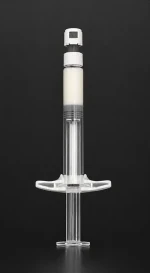
Thermicra drug product
- Thermicra formulation is a suspension in a non-aqueous medium.
- Prefilled syringes and autoinjectors are being evaluated for subcutaneous injection of the formulation.
Mechanism of SC absorption
Using the lymphatic system for systemic absorption
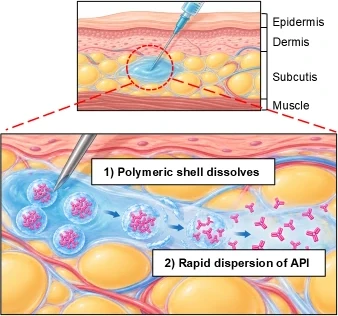
01
SC injection & API dispersion
- Once administered into the subcutis, the polymeric shell dissolves and releases the API into the interstitial space.
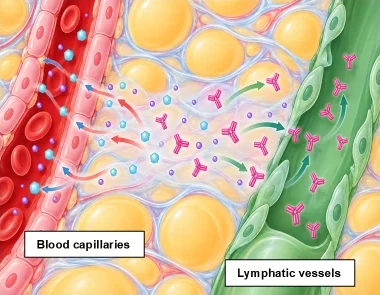
02
Interstitial transport & lymphatic uptake
- Small molecules and proteins (<16 kDa) diffuse into the blood capillaries.
- Large proteins (>16 kDa, e.g. mAbs and ADCs) are taken up into the lymphatic vessels.
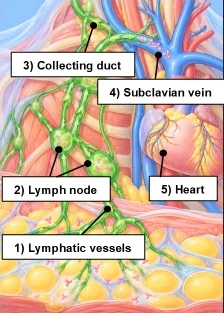
03
Lymphatic transport to systemic circulation
- Lymphatic vessels → draining lymph nodes → collecting duct → subclavian vein → heart (systemic circulation).
Adapted from Viola M, et al. J Control Release. 2018;286:301–314.
Measured: how fast it leaves the injection site
Fluorescence-labelled IgG injected SC at 10 mg/kg in mice, as a solution and as Thermicra particles, and imaged at the injection site for 5 days.
Fluorescence at the injection site Mouse · SC · 10 mg/kg
IgG solutionIgG as Thermicra particles
Same clearance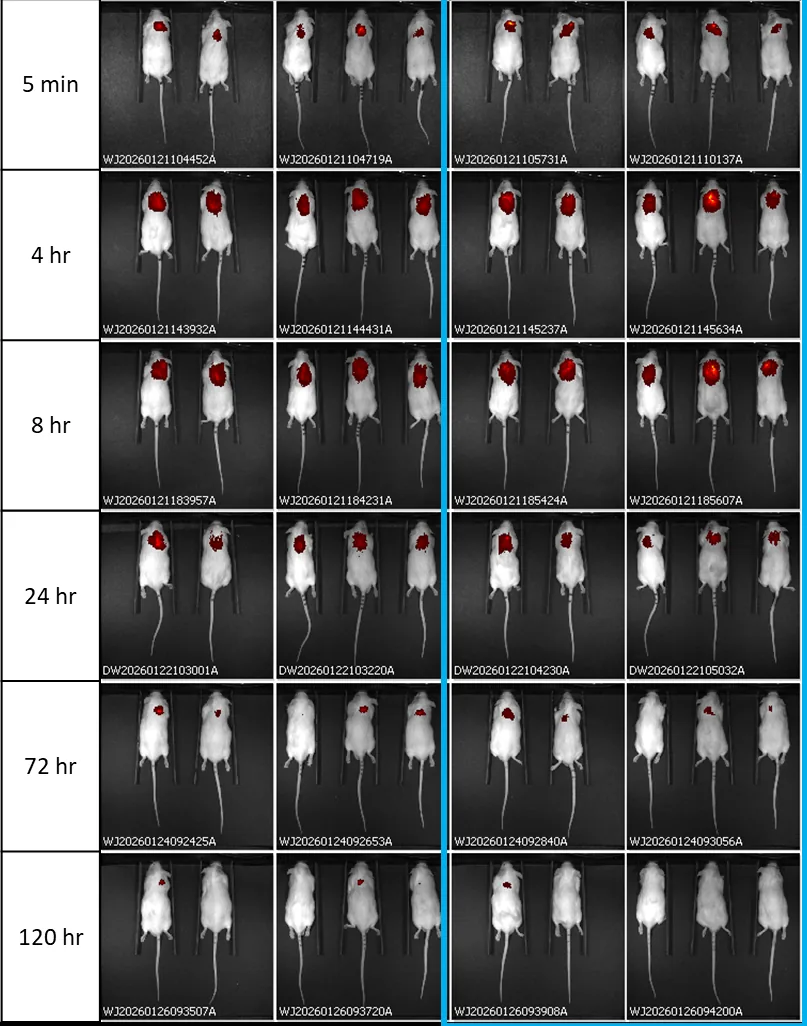
Thermicra particles leave the injection site at the same pace as an IgG solution: the formulation does not hold the drug back, and absorption follows a standard SC dose.
03 — Proof of concept
Proven with an ADC and an antibody, from cells to animals
In vitro · comparability to the reference product
Binding and cell killing in two cancer cell lines. The acceptance criterion was met in all four assays.
Reference productThermicra formulation
Binding affinity
Cell line A
- vs. reference
- 98%
- EC50
- Under CDA
Comparable · Pass
Binding affinity
Cell line B
- vs. reference
- 110%
- EC50
- Under CDA
Comparable · Pass
Cytotoxicity
Cell line A
- vs. reference
- 100%
- IC50
- Under CDA
Comparable · Pass
Cytotoxicity
Cell line B
- vs. reference
- 110%
- IC50
- Under CDA
Comparable · Pass
In vivo · pharmacokinetics, SC vs. IV
Single doses in rabbits and minipigs, against the reference product given as an IV infusion.
Reference product · IVThermicra formulation · SC
Total antibody
NZW rabbit
- Absolute bioavailability
- ~74%
Sufficient SC delivery
Total antibody
Yucatan minipig
- Dose-normalized bioavailability
- Under CDA
Preliminary · full study planned
Antibody · against the marketed product
A marketed anti-IL-4Rα IgG4 reformulated at three times its marketed concentration, and a marketed anti-PD-1 antibody as Thermicra particles.
Marketed productThermicra formulation
Plasma concentration
SD rat
Anti-IL-4Rα IgG4, single 10 mg/kg SC dose: the marketed product at 150 mg/mL and Thermicra Formulations 1 and 2 at 450 mg/mL
Marketed product · 150 mg/mLFormulation 1 · 450 mg/mLFormulation 2 · 450 mg/mL
- Concentration
- 150 → 450 mg/mL
Profiles overlap
Cell binding
Anti-PD-1 antibody
The marketed product and the same antibody as Thermicra particles
- vs. marketed product
- No significant difference
Binding intact
Compounds and cell lines are not named. Raw values (EC50, IC50, AUC, Cmax) and full datasets are shared with partners under CDA.
Request the data under CDA04 — GMP manufacturing
Aseptic GMP for ultra-high-concentration biologics
 Run with Daewoong Group's GMP and quality expertise — the group behind U.S. FDA cGMP manufacturing of biologics such as Nabota®.
GMP samples and clinical supply
2H 2027
Our aseptic GMP line can produce samples from the second half of 2027.
Planning clinical supply of your antibody or ADC? Manufacturing slots for partner material are limited — contact us to secure one.
Reserve a GMP slotPhase 01 · 2H 2027
Preclinical & launch supply
Aseptic manufacturing
- Site
- Seongnam, South Korea
- Status
- Operational from 2H 2027
Phase 02 · Next
Commercial supply
Global mass-commercial equipment
- Site
- Osong, South Korea
05 — Compatible payloads
What you can bring
One process for every payload
We have secured a robust formulation process that handles all of these modalities — from conventional antibodies to cytotoxic and oligonucleotide conjugates — at ultra-high concentration, keeping viscosity injectable and the molecule intact.
- Ultra-high concentration in a small volume
- Viscosity kept in an injectable range
- Structure, activity and conjugate integrity preserved
A
mAbs
Monoclonal antibodies
Full-length IgG antibodies, the largest class of biologics.
Why SC
- Many mAbs are dosed in the hundreds of milligrams to grams and given as hospital IV infusions that take an hour or more, plus chair time and observation.
- An SC injection takes minutes and can move treatment to the clinic room or the patient's home, cutting infusion capacity, staff time and overall cost of care.
- A new high-concentration SC presentation extends the life cycle of a marketed antibody.
What makes it hard
- A practical SC injection holds only about 1–2 mL, so a high dose has to be packed to well above 100 mg/mL.
- At that concentration, protein–protein interactions make viscosity rise steeply, until the solution can no longer be pushed through a fine needle.
- Crowded antibodies self-associate, aggregate and form particles, which can raise immunogenicity and shorten shelf life.
- Absorption runs slowly through the lymphatics, and part of the dose is lost before it reaches the blood, so bioavailability is incomplete.
B
ADCs
Antibody–drug conjugates
Antibodies carrying a highly potent cytotoxic payload on a chemical linker.
Why SC
- Almost every ADC is given by IV infusion, whose early concentration peak (Cmax) drives payload-related toxicity and limits the dose.
- Slower SC absorption is expected to blunt that peak and hold exposure within the therapeutic window, for potentially better safety and efficacy.
- Few targets suit ADCs, and linker or payload changes rarely set a program apart in the clinic — a better delivery profile is a way to differentiate.
What makes it hard
- Hydrophobic linker–payloads make ADCs far more prone to aggregation than the parent antibody, and the risk climbs with drug-to-antibody ratio and concentration.
- The linker must stay intact in the vial and in the SC depot; premature payload release means off-target toxicity.
- A potent cytotoxin held at the injection site raises the bar for local tolerability.
- Concentrating must not shift the drug-to-antibody ratio distribution, and handling a high-potency payload needs aseptic manufacturing with containment.
C
AOCs
Antibody–oligonucleotide conjugates
Antibodies that carry an siRNA or antisense oligonucleotide to tissues it cannot reach alone.
Why SC
- AOCs are being developed for chronic and often rare diseases that need repeated dosing for years, where frequent IV infusions weigh heavily on patients and caregivers.
- SC opens home or near-home dosing for life-long therapy.
- Unconjugated oligonucleotides are already given SC; delivering the conjugate the same way keeps the convenience patients expect.
What makes it hard
- A hybrid of a large protein and a densely charged polyanionic oligonucleotide behaves like neither, so antibody or oligonucleotide formulations do not simply carry over.
- Charge-driven interactions raise viscosity and self-association as the concentration climbs.
- Both the oligonucleotide and the linker must survive concentration and storage without cleavage or degradation.
- Tissue delivery calls for a high antibody dose, so the drug has to be concentrated hard into a small SC volume.
D
Bispecifics
Bispecific antibodies
Engineered antibodies that bind two targets at once, such as T-cell engagers.
Why SC
- For T-cell engagers, SC dosing is expected to soften the early peak that can trigger cytokine release syndrome.
- Step-up and frequent dosing regimens are far more practical as short SC injections than as repeated infusions.
What makes it hard
- Non-natural, often asymmetric formats are usually less stable than a standard IgG and more prone to aggregation.
- Each format behaves differently, so the formulation has to be tailored molecule by molecule.
- Self-association and viscosity rise at high concentration, as for mAbs, but with less margin.
- Immunogenicity has to be watched closely, since the SC route can raise it.
E
Proteins
Therapeutic proteins
Enzymes, fusion proteins, cytokines and other non-antibody biologics.
Why SC
- Many are replacement or chronic therapies given by frequent, life-long IV infusion; SC brings them home.
- Short-lived proteins need frequent dosing, which only SC makes practical.
What makes it hard
- Many are less robust than antibodies and unfold, aggregate or lose activity when concentrated.
- Activity, glycosylation and higher-order structure have to be preserved through formulation and storage.
- Large proteins are absorbed slowly and incompletely through the lymphatics.
- Aggregates raise the risk of anti-drug antibodies.
06 — Partnering use cases
How partners use Thermicra
01
IV → SC conversion
Move an IV biologic to a subcutaneous injection.
02
Lifecycle management
Extend a marketed biologic with a new high-concentration SC presentation.
03
Subcutaneous ADC
Develop an antibody–drug conjugate for subcutaneous administration.
07 — IP & readiness
Built to be partnered
- Intellectual property
- Protected by a portfolio of platform patent applications, filed and under prosecution. Details are shared under a CDA.
- Manufacturing readiness
- Dedicated aseptic GMP line for ultra-high concentration biologics in Seongnam, Korea to be operational by 2H of 2027 followed by plans to establish a large-scale commercial site in Osong.